Introduction: A Shift in Fiscal Strategy
The Union Budget 2025-26 signals a fundamental shift in India’s economic strategy, transitioning away from government-led demand creation to a private-sector-driven growth model. Over the last decade, the government has played a significant role in driving infrastructure development, boosting rural welfare, and providing direct fiscal stimulus. However, with government expenditure as a share of GDP declining from 15.6% in 2024-25 RE to 15.0% in 2025-26 BE, the government is now placing more responsibility on households and businesses to drive economic expansion.
This approach aligns with the government’s commitment to fiscal consolidation, ensuring long-term economic stability while reducing fiscal deficits and public debt burdens. The expectation is that private consumption and investment will take the lead in driving GDP growth, job creation, and economic momentum. However, this transition also presents significant challenges—particularly if rural demand remains sluggish, private sector investment remains cautious, and inflationary pressures persist.
In past years, India has seen several phases of economic transition, from the government-driven public sector boom in the 1950s–1980s to the market-oriented liberalization of the 1990s. The current fiscal approach marks yet another critical moment in India’s economic trajectory, and its success depends on how effectively the private sector steps in to compensate for the reduction in direct government stimulus.
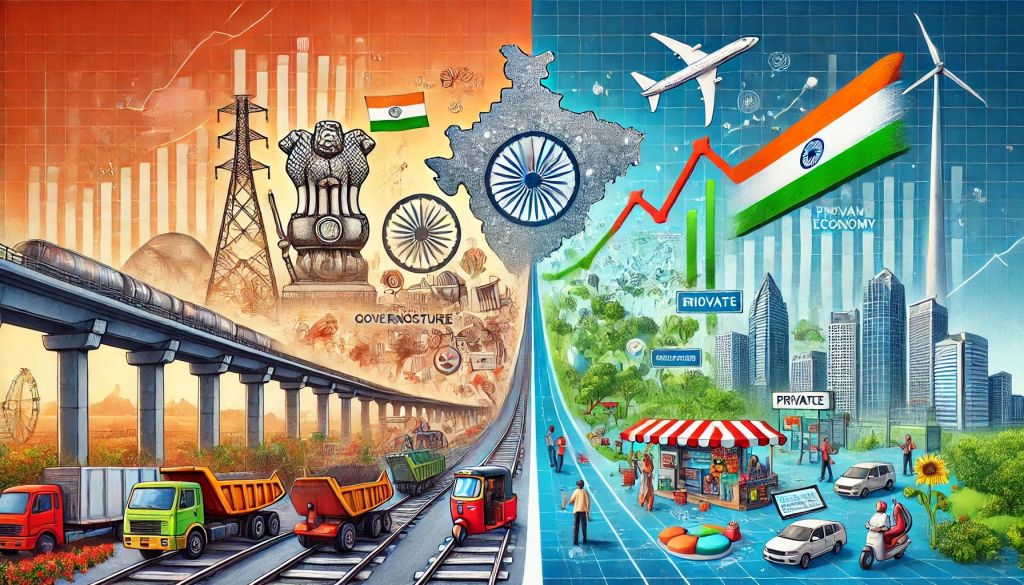
Moving Away from Government Spending as the Primary Growth Driver
For much of the past decade, India’s growth has been partially fueled by rising public expenditure. Capital investment in infrastructure, roadways, railways, rural electrification, and affordable housing schemes has played a key role in driving demand and employment. Additionally, subsidies and welfare schemes have supported low-income households, helping sustain consumption even during economic downturns.
However, the 2025-26 budget signals a clear attempt to reduce this reliance on direct government spending.
This shift is reminiscent of the fiscal consolidation efforts undertaken in the early 2000s, when the government curbed public spending to control inflation and reduce deficits. However, during that period, private investment played a major role in offsetting the slowdown in public expenditure—a factor that remains uncertain in the current scenario.
Positives of This Shift
- Greater Fiscal Stability and Lower Inflationary Risks
- Reducing the government’s fiscal deficit prevents excessive borrowing, which in turn keeps inflationary pressures in check.
- A more balanced fiscal policy ensures that monetary policy remains effective, allowing interest rates to remain stable.
- Encouraging Market-Led Growth
- A lower share of government-led spending creates more room for private enterprises to expand.
- Sectors such as real estate, manufacturing, and services could benefit from increased investor confidence due to stable fiscal policies.
Challenges and Risks
- Potential Demand Gaps If Private Investment Is Slow
- If businesses do not increase capital spending, the reduction in public expenditure could result in demand contraction, slowing overall GDP growth.
- The Make in India and Production-Linked Incentive (PLI) schemes have encouraged industrial investment, but their impact on private capital expenditure remains uneven, raising concerns about whether private players can absorb the demand gap left by reduced government spending.
- Unequal Growth Distribution
- While urban centers may see faster growth, rural areas, which depend more on government support, might face a slower recovery.
- The two-wheeler, FMCG, and agricultural sectors, which are still struggling with subdued rural demand, could be impacted.
Private Consumption: Can Households Drive Economic Growth?
With government spending moderating, private consumption is expected to take center stage as the primary driver of demand. However, consumption trends in India are highly dependent on two key segments—rural demand, which is influenced by agriculture and welfare policies, and middle-class consumption, which is shaped by tax incentives and employment trends.
Rural Demand and Consumption: Analyzing the Impact
Rural India is a crucial engine of India’s economic activity, contributing significantly to overall consumption demand. However, rural demand recovery has been slow, and wage growth remains uneven across sectors.
Key Trends in Rural Development Spending
- Rural development expenditure as a share of the total budget remains stable at around 5.26% in 2025-26 BE, similar to the previous year.
- MGNREGA, a critical employment safety net, remains stagnant at 1.18% of total expenditure, despite a higher revised allocation in 2024-25 due to increased demand for work.
The government’s assumption is that rural employment will recover due to increased private sector activity. However, the actual ground reality is more complex—many rural workers still rely on MGNREGA for income security, and if private employment generation remains weak, rural demand could face significant pressure.
Pros of the Rural Development Strategy
- Rural Infrastructure Investments for Long-Term Gains
- Government focus on rural roadways, irrigation, and power infrastructure aims to enhance rural productivity and reduce dependence on government support.
- More Opportunities for Private Sector Expansion
- With a reduced government footprint, sectors such as agriculture technology, digital payments, and e-commerce could expand into rural markets, providing alternative avenues for income and employment.
Challenges and Risks
- Slow Rural Wage Growth and Agricultural Uncertainty
- If farm incomes do not increase sustainably, rural households may cut back on discretionary spending, impacting consumer-driven sectors.
- Potential Weakness in MGNREGA-Dependent Regions
- States with high reliance on MGNREGA (such as Bihar, Madhya Pradesh, and Rajasthan) may see demand stagnation if private sector job growth does not materialize.
Middle-Class Consumption: The Role of Tax Relief
The government has provided tax relief measures aimed at boosting middle-class disposable income. The expectation is that this will stimulate discretionary spending, thereby creating higher demand in urban markets.
Pros of Tax Relief
- Higher Disposable Income Could Spur Demand in Key Sectors
- The automobile, electronics, and real estate sectors could benefit from higher purchasing power among salaried professionals.
- Potential Growth in Formal Sector Participation
- Higher after-tax earnings may encourage more workforce participation in formal jobs, strengthening long-term economic stability.
Challenges and Risks
- Limited Impact on Lower-Income Groups
- Tax benefits primarily help salaried workers, while self-employed and informal sector workers may not experience significant gains.
- Inflationary Pressures Could Offset Gains
- If inflation remains high, the additional disposable income may go toward essentials rather than discretionary spending.
Private Investment: The Most Critical Factor in Economic Growth
The next section will analyze private investment trends, corporate capital expenditure cycles, foreign direct investment (FDI), and sector-wise investment trends, ensuring a comprehensive analysis of the budget’s impact on India’s economic transition.
[To be continued…]

