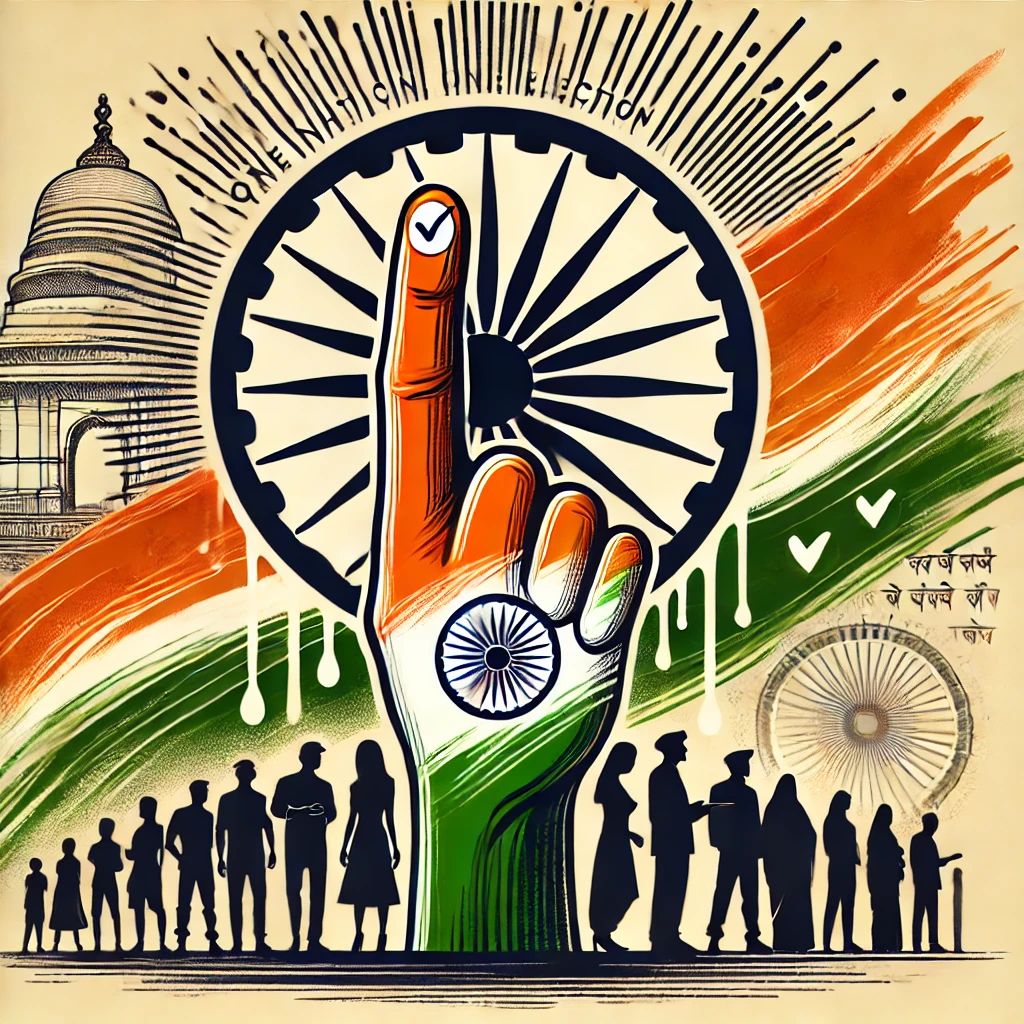
The proposal for One Nation, One Election (ONOE) has sparked a wide-ranging debate in India, touching on issues of governance, federalism, cost efficiency, and democratic integrity. While the idea has been revisited multiple times since its initial proposal in the 1980s, the contemporary context of its discussion makes it pertinent to evaluate its feasibility and implications.
Historical Perspective
India initially practiced simultaneous elections for the Lok Sabha and state assemblies from 1951 to 1967. The system was disrupted by premature dissolution of certain state assemblies in 1968 and 1969 and the Lok Sabha in 1970. Since then, elections have been held in a staggered manner, with some states holding elections alongside Lok Sabha polls, while others have separate electoral schedules.
Simultaneous elections have been revisited multiple times:
- 1983: The Election Commission of India (ECI) recommended simultaneous polls in its annual report.
- 1999: The Law Commission suggested the same in its report.
- 2017: NITI Aayog released a working paper detailing the benefits and challenges.
- 2024: The Ram Nath Kovind Committee provided a detailed roadmap, adopted by the Union Cabinet.
Merits of One Nation, One Election
1. Cost Efficiency
India spends heavily on elections. The 2019 Lok Sabha elections cost approximately Rs 60,000 crores, with only 15% being official government expenses. In 2024 this costs surprassed to over Rs 75,000 crores. Frequent elections across states multiply this cost. Simultaneous polls could streamline these expenditures, with a one-time investment in Electronic Voting Machines (EVMs) and resources.
2. Reduced Policy Disruption
Frequent elections necessitate the enforcement of the Model Code of Conduct (MCC), which restricts new policy announcements and diverts government attention to electoral preparations. ONOE would ensure uninterrupted governance and more time for development.
3. Governance and Focus
Political leaders often remain in “election mode” due to the staggered electoral cycle, reducing focus on governance. ONOE would allow leaders to dedicate their time and energy to policymaking and implementation, reducing the burden of constant campaigning.
4. Voter Turnout and Engagement
Simultaneous elections could increase voter turnout by consolidating elections into a single event. Voters would engage in the democratic process comprehensively, considering issues at national, state, and local levels simultaneously.
Challenges of One Nation, One Election
1. Threat to Federalism
India’s federal structure grants autonomy to states and local bodies to address issues specific to their jurisdictions. Simultaneous elections may lead to the domination of national narratives, overshadowing state and local issues, which undermines the essence of decentralization.
2. Logistical and Operational Challenges
India’s scale and diversity present unique logistical challenges:
- Ensuring free and fair elections in 1.3 billion-strong democracy across 28 states and 8 Union Territories (UTs) simultaneously is daunting.
- Acquiring and maintaining the required EVMs and VVPAT machines would require substantial planning and expenditure.
- Securing polling stations and managing personnel across the country on a single date would stretch resources.
3. Stability Concerns
Historical instances of premature dissolution of governments raise questions about sustainability:
- If a state government or the Lok Sabha falls before its term ends, re-aligning the electoral cycle would be problematic.
- Imposition of President’s Rule in states to maintain alignment could centralize power, raising concerns about undermining democratic norms.
4. Democratic Representation
Simultaneous elections could dilute the focus on regional and local issues. National concerns might dominate over state and local governance matters, leading to a mismatch between electoral narratives and the jurisdictional scope of governments. The national government focuses on central issues like national security, foreign policy along with certain concurrent issues( joint issues) with the state government. The state government on the other hand focuses on the law and order of the state along with other issues. Then there are local bodies like panchayats and municipalities which focus on more local issues. Now if there is one.simultaneous election, all these issues might lose the importance and only a few of them get resonance with the voters.
5. Legal and Constitutional Amendments
The proposal requires amendments to key constitutional provisions, including:
- Article 83: Duration of the Lok Sabha.
- Article 172: Tenure of state legislatures.
- Article 85 and Article 174: Dissolution of Parliament and assemblies.
- Article 356: Imposition of President’s Rule.
Additionally, the Representation of People Act, 1951, would need to be amended to ensure tenure stability.
Implementation Strategies
There are multiple challenges. There have been situations earlier when some state governments have lost their majority and fallen in between the terms. Similarly as we know in 1979, 1991, 1998 and 1999 the central governments had failed to fulfil the full term and mid term elections had to be called. What is going to happen then?. All of these have to be considered
If ONOE is to be implemented, the following strategies can be considered:
- Phased Introduction: Begin with simultaneous Lok Sabha and some state assembly elections, gradually aligning others.
- Fixed Tenures: Introduce measures to ensure governments complete their terms, such as constructive votes of no-confidence and provisions for alternate governments.
- Infrastructure Investment: Expand ECI’s capabilities to manage elections on this scale, including procurement of new EVMs and enhanced personnel training.
- National Consensus: Engage political parties, civil society, and experts to build a consensus, ensuring the proposal does not appear partisan.
Present Context
India’s current political and administrative environment presents a unique backdrop for this debate:
- Increased Polarization: Political and ideological divides could complicate consensus-building.
- Technological Advancements: EVMs, VVPATs, and digital voter databases make simultaneous elections more feasible today than in the past.
- Global Examples: Countries like Sweden, Germany, and South Africa successfully conduct simultaneous polls, providing potential blueprints for India.
Conclusion
The concept of One Nation, One Election offers a vision of streamlined governance and electoral efficiency. However, its implementation must address the complexities of India’s federal structure, democratic representation, and logistical challenges. While cost efficiency and governance benefits are undeniable, the risks to federalism and sustainability demand careful deliberation.
The proposal requires a balanced approach, fostering a national consensus that respects the diversity and complexity of Indian democracy. Only through inclusive dialogue and phased implementation can ONOE transition from a theoretical concept to a practical reality, ensuring it strengthens rather than undermines India’s democratic fabric.

