The Maharashtra Assembly Elections 2024 are expected to be a close battle between the Maha Vikas Aghadi (MVA) and the Mahayuti alliance. In the recently concluded loksabha election based on the vote share there was only a marginal difference between the two alliances.
As per the methodology of our analysis we have looked into over 100 plus news articles and television videos on the election from October 1st to November 19th along with past election data from constituency wise from 2024 loksabha and 2019 Vidhan sabha and applied generative AI based analysis on the combined data. Our findings are based on the analysis results. Please note that this is not an exit poll. This is an analytical projection based on data.
The range of vote share predicted clearly suggests that a couple of percentage point changes from the mid point( on the basis of which seat projections are made) here or there will have a significant impact on the result in such a close bipolar fight and can make the election one sided.
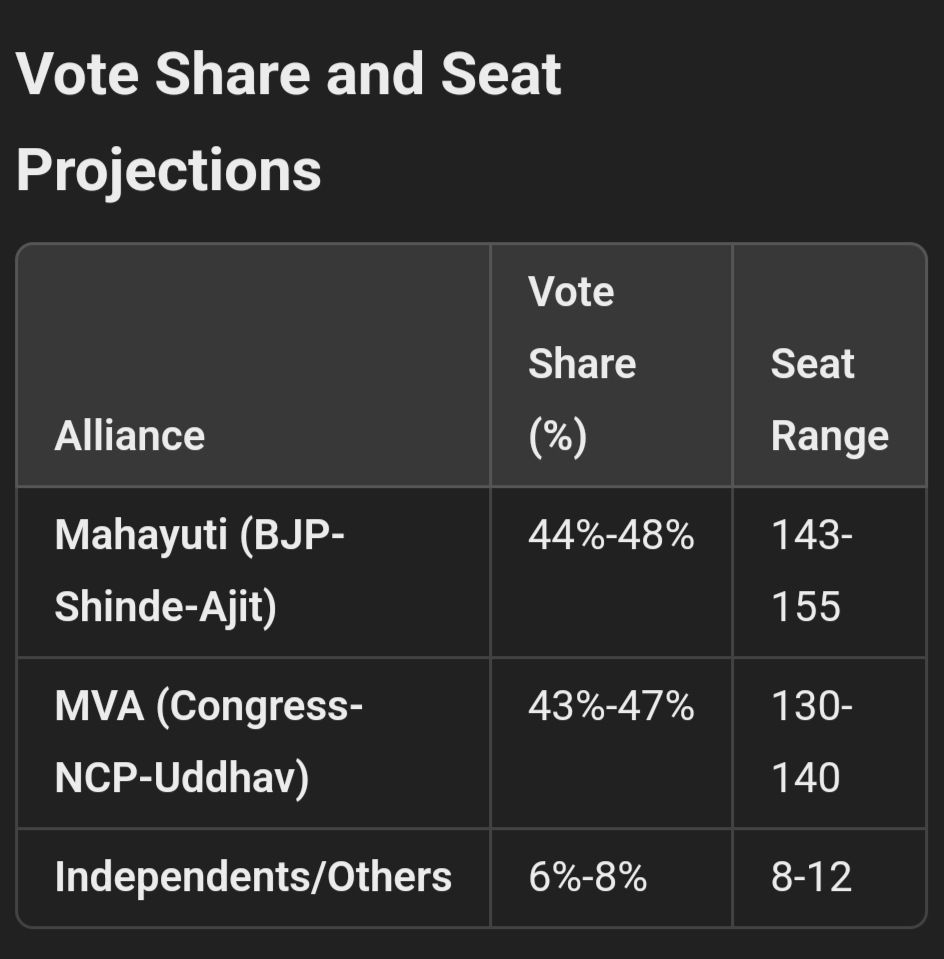
Mahayuti is projected to have a slight edge statewide, driven by strongholds in Konkan, Thane, and Northern Maharashtra, and a solid presence in urban centers like Mumbai and Nagpur. Meanwhile, the MVA remains strong in Western Maharashtra, rural Vidarbha, and parts of Marathwada, capitalizing on agrarian distress and cooperative politics. While independents and smaller parties are not expected to win many seats, their influence on vote shares in key regions could be significant. They can make a significant impact in the final verdict of each and every seat.
Let us now focus on the region level findings. As many experts say, there are actually 6 elections within one election this time in Maharashtra. While the election appears very close at the overall level it is not the case in all regions.
Western Maharashtra (70 seats)
– Region Profile:
Western Maharashtra is characterized by its dominance of sugar cooperatives, agrarian politics, and urban hubs like Pune and Kolhapur.
– Key Issues:
– Farmer distress and irrigation concerns.
– Cooperative politics and sugar industry influence.
– Urban infrastructure and development in Pune.
– Political Dynamics:
– MVA:NCP and Congress maintain strong support due to their control of cooperatives and effective outreach to farmers. Sharad Pawar’s legacy remains pivotal. MVA is expected to lead in this region.
– Mahayuti:Gains in urban hubs like Pune due to Ajit Pawar’s defection, but limited success in rural areas dominated by the MVA.
– Independents/Others: Farmer-focused outfits like Swabhimani Shetkari Sanghatana may secure 1-3 seats in areas where NCP faces internal dissent.
Vidarbha (62 seats)
– Region Profile:
Vidarbha is a region of contrasts, with urban BJP strongholds like Nagpur and rural areas grappling with severe farmer distress and tribal issues.
– Key Issues:
– Farmer suicides, agrarian distress, and Vidarbha statehood demand.
– Tribal welfare and infrastructure development in urban centers.
– Political Dynamics:
– MVA:Congress gains in rural areas due to its farmer-centric promises. The NCP has a limited presence here but supports Congress’s efforts.
– Mahayuti: BJP dominates urban areas like Nagpur with its RSS roots and organizational strength. Ajit Pawar’s faction strengthens their semi-urban outreach.
Overall this region is expected to see a very close fight and the seat share between the two alliances might also be very close.
– Independents/Others:Local tribal leaders and Vidarbha statehood activists may secure 2-3 seats, impacting MVA’s vote share.
Marathwada (46 seats)
– Region Profile:
A drought-prone and rural region, Marathwada includes urban hubs like Aurangabad (Sambhajinagar). Minority voters play a significant role in urban constituencies.
– Key Issues:
– Drought management and farmer relief.
– Minority welfare and urban development.
– Political Dynamics:
– MVA:Gains in rural constituencies due to agrarian issues and Congress’s focus on drought mitigation.
– Mahayuti:Performs better in urban and semi-urban areas, but struggles in rural Marathwada.
This is a region expected to be dominated by the MVA but not as much as it was during the loksabha polls.
– Independents/Others: AIMIM could win 1-2 seats in urban minority-dominated areas like Aurangabad.
Konkan and Thane (39 seats)
– Region Profile:
This region combines the coastal, rural Konkan areas with the urbanized hubs of Thane and Navi Mumbai.
– Key Issues:
– Fisherfolk concerns in Konkan.
– Urban infrastructure and housing in Thane and Navi Mumbai.
– Political Dynamics:
– Mahayuti:Shinde’s faction dominates rural Konkan, while BJP consolidates its position in Thane and Navi Mumbai.
– MVA:Struggles to regain lost ground in urban and rural areas due to Shinde’s defection.
Mahayuti expects to have a lion’s share of seats in this region with minimal inroads by Uddhav sena.
– Independents/Others:Local leaders focusing on fisherfolk issues may secure 1-2 seats.
Mumbai (36 seats)
– Region Profile:
Mumbai’s urban landscape includes affluent neighborhoods, working-class areas, and minority-dominated constituencies.
– Key Issues:
– Housing, infrastructure, and cost of living.
– Political Dynamics:
– MVA:Gains in working-class and minority areas. Congress and Uddhav’s Shiv Sena maintain a strong presence in suburban constituencies.
– Mahayuti:Strong in affluent and middle-class areas, where BJP’s urban appeal is most effective.
This is again another region which is expected to see close fights with a slight edge to Mahayuti with the tilt of urban votes in favour of them but Uddhav’s image in Mumbai poses a close fight.
– Independents/Others: MNS may disrupt alliances in 1-2 seats.
Northern Maharashtra (35 seats)
– Region Profile:
A predominantly rural region with urban hubs like Nashik and Jalgaon.
– Key Issues:
– Cooperative politics and agrarian distress.
– Urban infrastructure and development in Nashik.
– Political Dynamics:
– Mahayuti:Gains in urban and semi-urban constituencies, with BJP leveraging its organizational strength.
– MVA:Retains influence in rural areas due to cooperative politics but struggles in urban centers.
This region is again going to witness a rural urban divide with an edge towards Mahayuti.
Let us now focus on the party dynamics. While the fight is between the two alliances, there are 76 seats where there is a direct fight between BJP and Congress, 50 seats where there is a direct fight between the two Shiv sena groups and 37 seats where the fight is between the two NCP fractions. The final outcome will depend a lot on how the fate of these 163 seats are decided.
Our analysis suggests that in terms of the fight between BJP vs Congress which is mainly happening in Vidarbha and Marathwada region, the outcome will be very close to prediction and it will be mostly 50 – 50 with a slight edge to BJP given the strength of RSS organisation on ground in Vidarbha region which can prove to be a crucial point while the agragain crisis and soyabeen and cotton issue can work on Congress’s favour.
In terms of the 50 seats where we are having a sena vs sena fight, which is mainly in the Thane- Konkan and Mumbai region, Shinde group is predicted to have a 60-40 edge over the Uddhav group mainly because of the dominance in the Thane- Konkan belt while Uddhav group appears to make some lost grounds in Mumbai region.
As far as the fight between the Pawars are cocerned in the 37 seats which mainly come from the Western Maharashtra belt and a few from Northern Maharashtra, our analysis predicts a clean sweep for the senior Pawar with a 70-30 tilt in favour of him as against his nephew.
The Mahayuti alliance, comprising the BJP, Eknath Shinde’s Shiv Sena faction, and Ajit Pawar’s NCP faction, is projected to hold a slight statewide lead, primarily driven by its dominance in urban centers and key regions like Konkan, Thane, and Northern Maharashtra. These areas have traditionally been strongholds for the BJP and Shinde group due to their well-organized cadre, robust urban outreach programs, and emphasis on urban focused infrastructure and economic development. The addition of Ajit Pawar to the alliance has also bolstered its support among some NCP factions, particularly in Northern Maharashtra and parts of Vidarbha.
Meanwhile, the MVA (Congress, Sharad Pawar’s NCP faction, and Uddhav Thackeray’s Shiv Sena faction) remains highly competitive, particularly in Western Maharashtra, rural Vidarbha, and Marathwada. These regions, characterized by their dependence on agriculture and cooperative networks, are likely to respond positively to the MVA’s campaign focus on agrarian distress, farmers suicides, unemployment, and social welfare. Sharad Pawar’s influence in rural politics and cooperative societies continues to play a pivotal role in consolidating the MVA’s vote base. Uddhav Thackeray’s Shiv Sena faction, despite being weaker than Shinde’s group organizationally, retains emotional and ideological appeal among certain sections of voters, especially in urban and semi-urban areas. Congress regains its rural support base specially given the growing distress from the ruling dispensation.
In Western Maharashtra, the cooperative sector remains a backbone of MVA support, with Congress and NCP working together to consolidate farmer and sugar mill worker votes. Vidarbha, though partially leaning toward Mahayuti due to BJP’s organisation strength, sees MVA’s inroads in the poorer districts where agrarian issues dominate. Marathwada, often plagued by drought and farmer suicides, has emerged as a battleground, with both alliances running neck and neck, driven by intense local campaigning.Maratha reservation remains a key factor here.
The Independents and smaller parties, while not expected to win many seats (projected at 8-12 statewide), can still have a significant impact. Their influence lies in tightly contested constituencies, where even a small vote share can tilt the balance. These smaller entities often thrive on hyper-local issues, caste-based politics, or dissatisfaction with the major alliances.
The overall election outcome will depend heavily on each alliance’s ability to mobilize its vote base in key regions. This includes managing internal conflicts (especially in the case of Mahayuti with its recent additions) and ensuring that ground-level workers are motivated and active. Turnout in urban centers, where BJP has a lead, and rural areas, where MVA has an edge, will be critical. Additionally, any missteps in the fag end could shift the dynamics in favor of the rival alliance.
Ultimately, the results will hinge on whether Mahayuti can sustain its urban momentum and extend it to rural areas, or if the MVA can convert its rural strongholds into decisive victories while clawing back some urban votes.
 Indian Political Debate
A very detailed and well researched report.
LikeLike