The Union Budget 2025-26 is a carefully calibrated financial plan aimed at maintaining fiscal discipline while fueling economic expansion. With total government expenditure at ₹50.65 lakh crore and a fiscal deficit target of 4.3% of GDP, this budget navigates the fine line between investment-driven growth and fiscal prudence. However, the real question remains—will this budget help reduce inequality and control inflation, or will it exacerbate existing economic disparities?
Fiscal Consolidation vs. Growth Aspirations
The government’s revenue projections for 2025-26 are ₹34.2 lakh crore in revenue receipts and ₹16.4 lakh crore in capital receipts. The rising tax collections, especially in corporate tax (₹10.82 lakh crore) and GST (₹11.78 lakh crore), suggest a recovering economy but also highlight a growing reliance on indirect taxation, which disproportionately burdens the middle and lower-income groups.
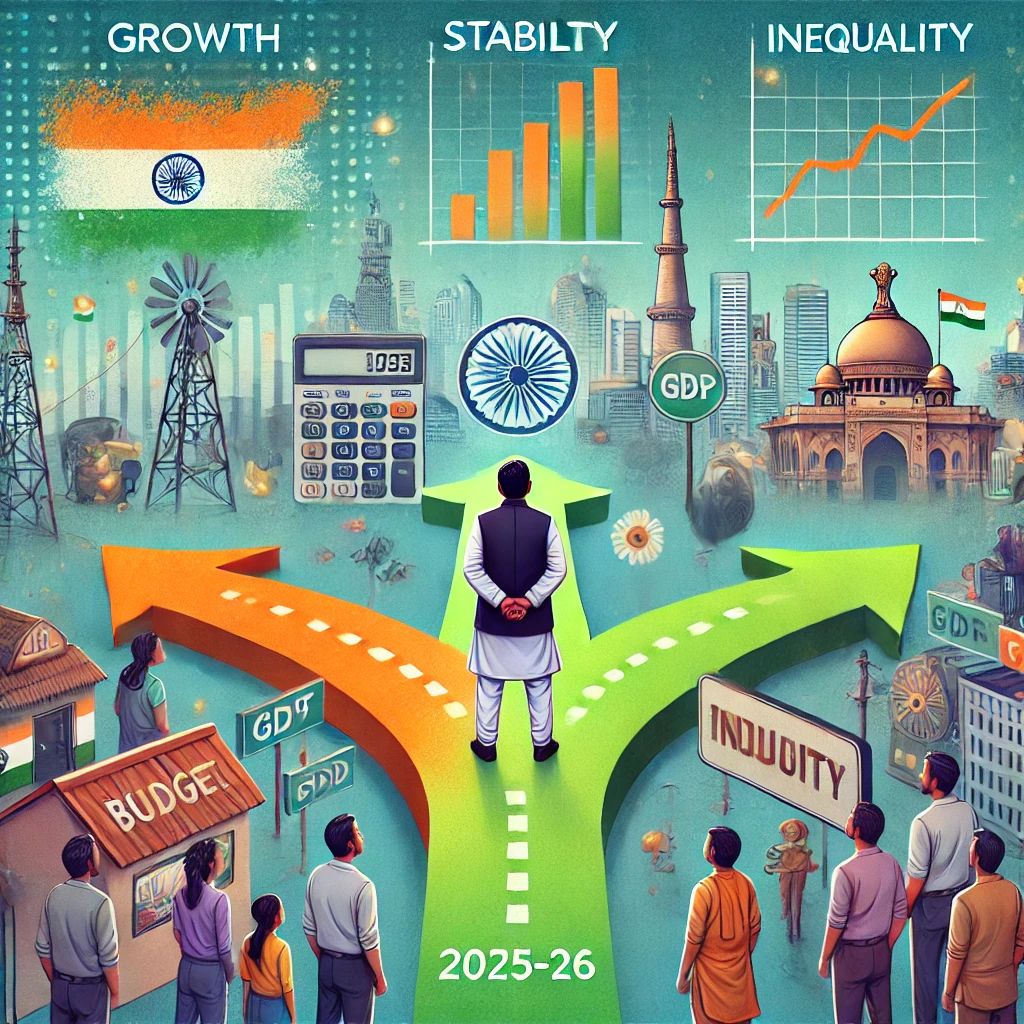
While direct tax collection (income and corporate taxes) is expected to grow, the increase in indirect tax receipts through GST and excise duties may contribute to inflationary pressures. The fiscal deficit reduction plan is crucial for macroeconomic stability, but it also means that the government is less likely to engage in large-scale fiscal stimulus, which could slow down demand in certain sectors.
Capital Investment: A Catalyst for Growth?
A notable highlight of the budget is the increase in capital expenditure, set at ₹11.2 lakh crore, along with ₹4.27 lakh crore in grants for capital assets, bringing the effective capital expenditure to ₹15.48 lakh crore. This substantial allocation towards infrastructure, transportation, and rural development could stimulate employment and private investment, setting the stage for long-term economic expansion.
However, the challenge lies in translating this spending into immediate consumption growth. While investment in roads, railways, and urban development will boost supply-side efficiency, its demand-side impact remains limited in the short term. Given that private consumption has been weak, a stronger focus on rural demand and social welfare schemes could have balanced growth more equitably.
The Unequal Burden: Rising Inequality and Demand Slowdown
One of the biggest concerns surrounding this budget is its potential impact on inequality. The tax burden continues to shift toward indirect taxes, which disproportionately affect lower-income groups. Additionally, food and fertilizer subsidies have been rationalized at ₹2.03 lakh crore and ₹1.67 lakh crore, respectively, which could put pressure on rural incomes and food prices.
While urban India benefits from higher corporate earnings and stock market gains, rural India faces stagnation in wages and employment. The allocation of ₹2.66 lakh crore to rural development, though substantial, may not be enough to bridge the growing income divide.
Moreover, pension spending (₹2.76 lakh crore) and social welfare (₹60,052 crore) remain relatively low compared to the scale of economic disparity, suggesting a lack of strong redistributive policies to counter the widening income gap.
Inflation Concerns: Will Price Pressures Persist?
Inflation remains a key economic challenge, particularly with food and energy prices experiencing volatility. The budget’s approach to taxation and subsidy cuts suggests that inflationary pressures may persist, as reduced subsidies could lead to higher costs for consumers.
- The reduction in food and fertilizer subsidies may lead to higher agricultural input costs, affecting food inflation.
- Increased excise duty and GST collections indicate higher indirect taxes, which often result in price hikes for essential goods.
- Rising interest payments (₹12.76 lakh crore) suggest that debt servicing remains a challenge, potentially influencing borrowing costs and inflation.
On the positive side, higher capital expenditure in infrastructure and logistics could ease supply-side bottlenecks, which may help moderate inflation in the long run. However, in the near term, consumers may continue to feel the pinch of high prices.
Where Does This Leave India’s Middle Class?
For the middle class, the budget presents a mixed picture. While tax collections are rising, there is significant relief in direct taxes, which means that discretionary income for a certain section of the population increases. But it also needs to be noted that the total tax payers are about 3-4 crores and out of that there will be only a certain section who will be in taxnet and below 12 lacs of income.
The healthcare and education sectors, which are critical for long-term human capital development, have received ₹98,311 crore and ₹1,28,650 crore, respectively. While these allocations support infrastructure, they may not necessarily reduce the out-of-pocket costs for the average Indian household.
Meanwhile, job creation remains a challenge. While the capital-intensive sectors like infrastructure and energy are expected to generate employment in the long run, the immediate impact on job creation in manufacturing and services remains uncertain.
Final Verdict: A Budget with Mixed Consequences
The Union Budget 2025-26 is pro-growth but with limitations. It prioritizes fiscal discipline, infrastructure expansion, and capital investment, which are crucial for long-term development. However, in the short term, the budget did take some steps to boost immediate consumption demand but the magnitude of impact is debatable and hence the impact on reduction of inequality is questionable.
While the focus on investment-led growth is commendable, the reliance on indirect taxes and reduced subsidies could worsen inflation and economic disparity. The higher burden on indirect tax means the citizens across all income class will have to take the burden with more severe impact on the poor households as per share of income going on taxes( direct + indirect). To achieve sustainable and inclusive growth, policymakers must complement capital spending with stronger demand-side measures, better income redistribution, and policies to support rural consumption.
 Indian Political Debate