Introduction
In recent years, the term “freebies” has become a buzzword in Indian political and economic discourse. From television debates to judicial interventions, the narrative around government welfare schemes has increasingly been framed in terms of “handouts” vs. sustainable development.” While critics argue that excessive giveaways strain public finances, proponents stress that such schemes are essential in a country with poverty and inequality. The real question is: Should all welfare initiatives be dismissed as “freebies,” or is there a nuanced difference between populism and essential state support?
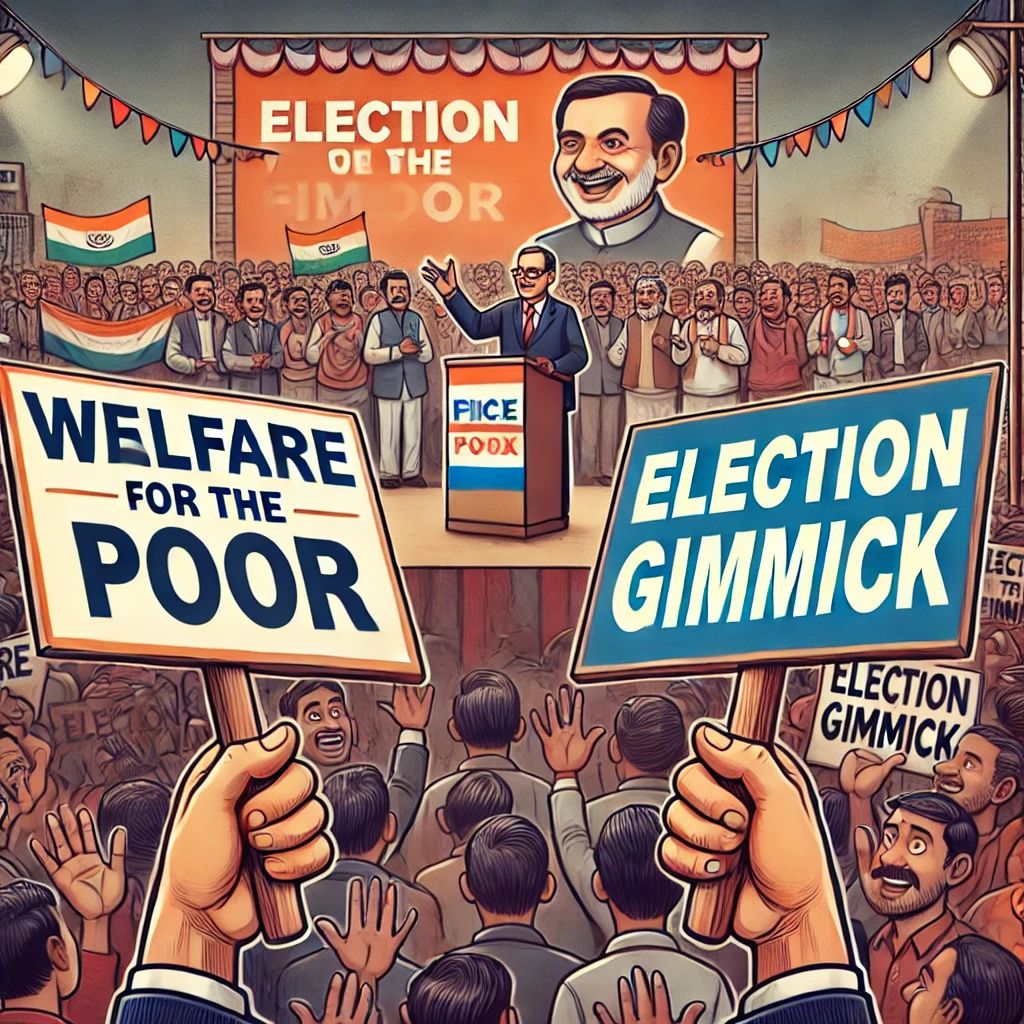
The Rise of the “Freebies” Narrative
The “freebies” discourse gained traction in India around 2012-2014, when various state governments introduced welfare measures like free laptops, TVs, and subsidized goods. However, it reached national prominence in 2022, when the Supreme Court of India took cognizance of the growing “freebie culture” and its economic impact.
Media narratives further amplified the issue, often branding pre-election welfare promises as “irresponsible populism.” Meanwhile, corporate leaders and policymakers warned that excessive welfare spending could lead to state-level financial crises, rising debt burdens, and economic instability. The debate, however, often ignores the fact that there is inherent inequality in the economy where state intervention is not just desirable but necessary.
Are Freebies and Welfare the Same?
While the term “freebies” carries negative connotations, not all government benefits can be classified as mere electoral gimmicks. The World Bank and UNDP recognize targeted welfare programs as instruments of economic empowerment. The difference lies in intent, impact, and sustainability.
1. Essential Welfare Schemes (Long-Term Development)
These are investments in human capital, aiming to reduce poverty, improve livelihoods, and promote economic mobility. Examples include:
✅ Public Distribution System (PDS): Free/subsidized food for poor families.
✅ MGNREGA: Guaranteed rural employment.
✅ Ayushman Bharat: Free healthcare for low-income households.
✅ PM Awas Yojana: Affordable housing for the poor.
These schemes address fundamental rights—food, health, education, and employment—essential for a developing country like India.
2. Short-Term Grants (Electoral Populism)
Some schemes prioritize immediate gratification over long-term economic growth and often emerge before elections. Examples include:
❌ Free TVs, washing machines, or consumer electronics without clear economic benefit.
❌ Free electricity for all, including affluent sections, without a sustainable revenue model.
❌ Unfunded cash transfers that increase state deficits without boosting productivity.
While these schemes may offer temporary relief, they risk undermining state finances if not backed by sustainable revenue sources.
The Economic Argument: Are “Freebies” Sustainable?
India has seen several instances where excessive welfare spending has led to fiscal distress. Some states have accumulated high debt levels due to large-scale subsidies. The Reserve Bank of India (RBI) has warned that unfunded giveaways could lead to financial crises in some states.
However, it is also important to note that corporate tax cuts, loan waivers, and subsidies for industries are rarely criticized as “freebies.” While the government regularly provides tax breaks to businesses, loan waivers and incentives to boost industrial growth, social welfare programs for the poor are disproportionately labeled as “freebies.” This selective criticism highlights the need for a balanced perspective.
Beyond the Rhetoric: Finding the Middle Ground
Instead of a blanket dismissal of welfare programs, the real policy challenge is to design social schemes that are both inclusive and fiscally responsible. Some key recommendations include:
✅ Targeted Subsidies: Instead of universal giveaways, subsidies should be targeted at the most vulnerable sections.
✅ Conditional Cash Transfers: Providing financial aid linked to education, skill development, and employment.
✅ Revenue-Backed Welfare Models: Ensuring that welfare programs have a clear funding mechanism rather than relying on excessive borrowing.
✅ Public Debate on Welfare Priorities: A parliamentary or judicial framework to evaluate which schemes qualify as essential welfare and which are short-term electoral sops.
Conclusion
The “freebies vs. welfare” debate must move beyond political posturing. While reckless populism can harm economic stability, essential welfare is the backbone of any developing economy. India’s policymakers must ensure that social schemes empower citizens without jeopardizing fiscal discipline. Welfare programs should be seen not as handouts but as investments in the nation’s future.
Instead of dismissing welfare as freebies, the focus should be on how to make welfare policies more effective, accountable, and sustainable. Only then can India balance growth with inclusivity, ensuring that economic progress benefits all sections of society, not just a privileged few.
 Indian Political Debate